More Frequently Asked Questions
Finance and Bond
Q: Why is the City asking for a $130 million bond if they intend to seek grant funding?
A: To access outside funding, the City must show it has the authority to fund the full project. Bonding for the full amount ensures eligibility for grant and loan programs that require match funding. This does not obligate the City to borrow the maximum — only the amount actually needed once grants and loans are awarded will be borrowed.
Q: What is a bond, and how does it work?
A: A bond is a financing tool, similar to a loan, that allows the City to borrow money for a large project and repay it over time. The City issues bonds to raise funds upfront and then makes scheduled payments, typically over several decades, using sewer utility revenues (not property taxes). This approach spreads costs more evenly, avoiding steep short-term rate increases.
Q: What happens if the bond does not pass?
A: The project is not optional—the City is required to meet state and federal permit requirements. Without bond authority, the entire cost would need to be covered directly through sewer rates, likely resulting in much higher short-term rate increases. If the bond fails, the City would need to rerun the election or increase rates to cash fund the project, delaying the project and potentially raising costs due to inflation, emergency repairs or fines.
Q: How will future growth and new connections pay their fair share?
A: A revised connection fee study will be conducted following the completion of the improvements so that new development pays toward the cost of new infrastructure. Impact fees and commercial development charges will also be applied as available.
Impact Fees vs. Wastewater:
Development Impact Fees (DIFs) in Sandpoint are limited to Parks & Recreation, Pathways, Roads, Police, and Fire. They can only pay for the growth-related share of new system capacity in those categories. They cannot be used to replace/upgrade existing wastewater facilities or meet new wastewater regulations. Because most WWTP work is replacement, DIFs cannot fund it. However, the City does have a tool for growth. New development pays a one-time Sewer New User Facility Fee (NUFF) at connection (about $6,000 per Residential Unit) which buys into system capacity. For example, a 10-unit apartment would pay roughly $60,000 to connect into the system. This is how growth pays its share for wastewater capacity.
Q: How will the City ensure transparency and keep the public informed about project progress and spending?
A: The City is committed to transparency. By law, bond proceeds can only be used for wastewater improvements. The City will provide quarterly updates, maintain a project website, and issue regular public reports. Expenditures will require Council approval and independent audits.
Project Background and Need
Q: What has the City been doing to prepare for this WWTP project?
A: Planning for wastewater facility replacement began years ago. In 2009, the City purchased land for potential future needs. In 2017, work began to evaluate long-term options, and in 2018 the City Council approved rebuilding at the existing plant site. The Wastewater Facility Plan was formally adopted in 2019, confirming the need for replacement. The Preliminary Engineering Report prepared by Keller Associates was completed in April 2025 and is located on the City of Sandpoint’s Engineering Services website.
Q: Is the project required due to community growth, or are there other reasons?
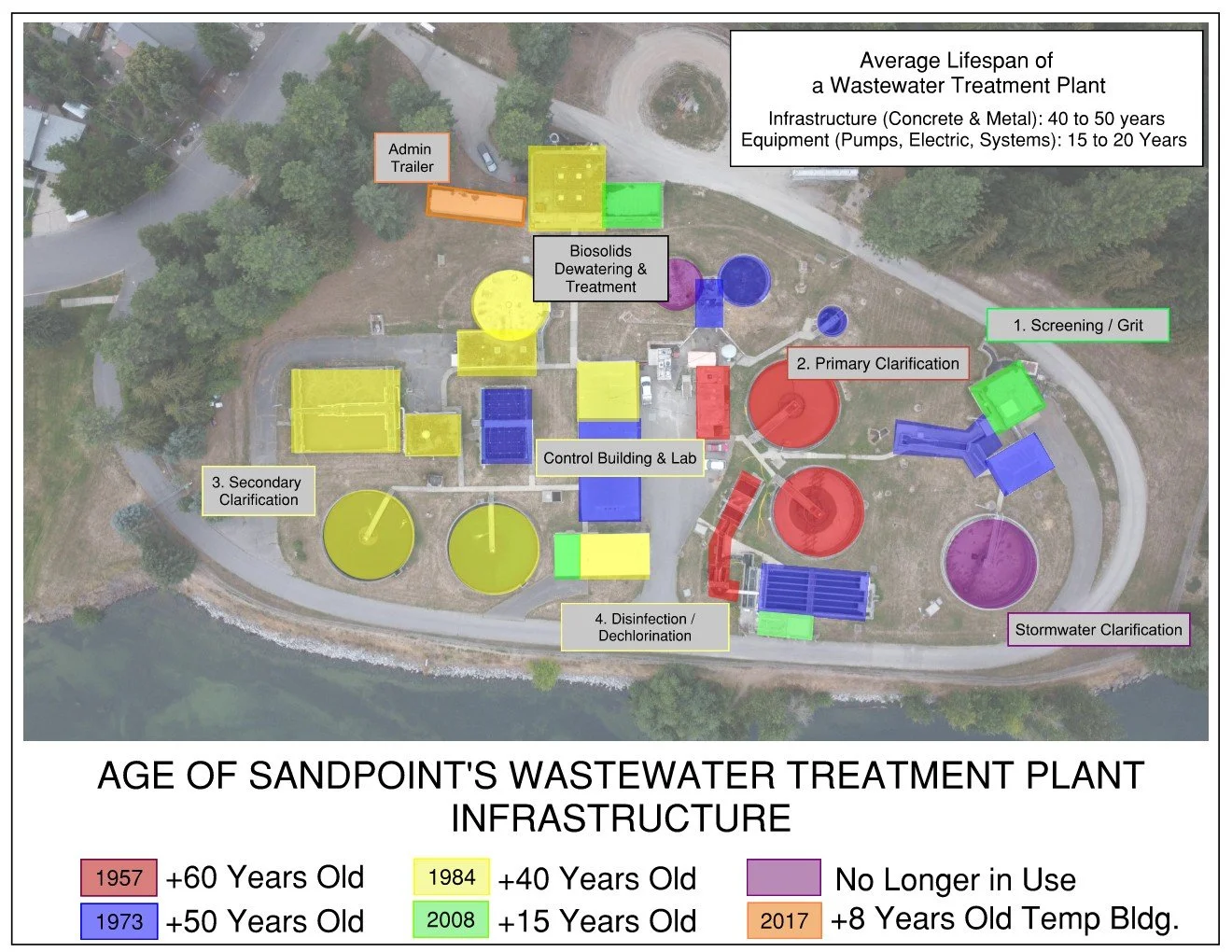
A: The project is primarily driven by aging infrastructure and meeting current environmental regulations, not growth. The average lifespan of a wastewater treatment plant’s infrastructure (concrete & metal) is 40 to 50 years, while the equipment (pumps, electrical, and computer/operating systems) is 15 to 20 years. Much of the infrastructure from the 1950s–1980s are at the end of their useful life, as they are over 40 to 60 years old (see the Age of Sandpoint’s Wastewater Treatment Plant diagram). Additional infrastructure was built in 1984 for secondary clarification. Some of these tanks’ geometry and capacity are inadequate for future needs.
The most recent infrastructure and equipment upgrade was in 2008 with the addition of the screening/grit stage, and add-ons to the biosolids dewatering and treatment and disinfection/ dichlorination stages. The equipment from this most recent upgrade is nearing its end of its lifespan being over 15 years old.
Maintenance and equipment upgrades have continued to occur over the years on an as needed basis, which can come at a higher cost, especially if needed immediately to meet permit requirements.
Both the plant’s infrastructure and equipment are failing and cannot reliably meet permit requirements, thus requiring reconstruction. Growth projections are included in this project’s design, but the main drivers for the reconstruction project are deficiencies in the current plant.
Q: What are state and federal permits required for?
A: The Clean Water Act requires the City to hold a discharge permit under the Idaho Pollutant Discharge Elimination System (known as IPDES). This permit limits pollutants such as:
BOD (oxygen depletion harmful to fish)
TSS (sediment that clouds water and smothers habitat)
Ammonia (toxic to fish)
Phosphorus (causes algae blooms)
E. coli (signals fecal contamination)
Chlorine (toxic to aquatic life)
Both infrastructure reconstruction and equipment upgrades are required to keep Sandpoint in compliance and protect our local waterways.
Q: What is being prioritized in the reconstruction of the Wastewater Treatment Plant?
A: The reconstruction focuses on replacing aged out infrastructure, ensuring proper sizing /geometry of tanks, providing redundancy of conventional treatment systems, upgrading electrical and technological operating systems and permit compliance, upgrading resilience against inflow and infiltration (I/I), addressing worker and public health and safety, and providing reliable long-term service.
Q: Couldn’t we just repair the old plant instead of rebuilding it?
A: The current plant was originally built in the 1950s, with some upgrades in the 1970s and 1980s. Many parts of the plant are well beyond their useful life and no longer meet current design standards. For example, the clarifiers and aeration basins are undersized for today’s needs and cannot be patched to meet future permit limits. Repeated emergency repairs would be more costly without solving the underlying problems. Rebuilding the plant ensures the City can meet state and federal requirements, protect the waters and public health, and provide reliable service for decades to come.
Q: Have you considered doing a regional system?
A: A regional facility was considered in the Wastewater Facility Plan but neighboring jurisdictions have chosen to move forward their own projects. A shared system would introduce governance, funding, and infrastructure challenges that are not feasible at this time.
Q: Why is the project staying on lakefront property instead of relocating?
A: Relocation of the treatment plant was evaluated in the Wastewater Facility Plan, but found financially and logistically prohibitive. Increased costs would be primarily due to the additional lift stations that would be needed to bring the collected wastewater to the treatment plant and then back to an approved discharge point/outfall.
Q: Why is the project being done all at once instead of being a longer period of time?
A: The full reconstruction project is being in phase of over the next five years. The majority of the facilities have reached or exceeded their useful life and require replacement as soon as possible to avoid costly emergency failures. While reconstruction improvements over a longer period was considered, it was determined to be less effective and more expensive. Spreading the work out would increase overall costs and prolong risk of system failures, and potentially expose the community to regulator violations and fines. Completing as much of the improvements over the next five years based on available funding and constructability phasing will help to provide timely replacement of this infrastructure and reduce long-term costs.
Q: Why has the project been deferred for so long, and what’s being done to prevent future deferrals?
A: Large wastewater projects are complex and expensive, which has led to deferrals in the past. The most recent improvements from 2008 (over 15 years old) are also reaching their useful life. The City is now addressing the issue comprehensively. Moving forward, updated connection fees, user facility charges, and structured rate studies will help ensure sustainable funding for maintenance and future improvements.
Technical Specifications/Information
Q: What is I/I?
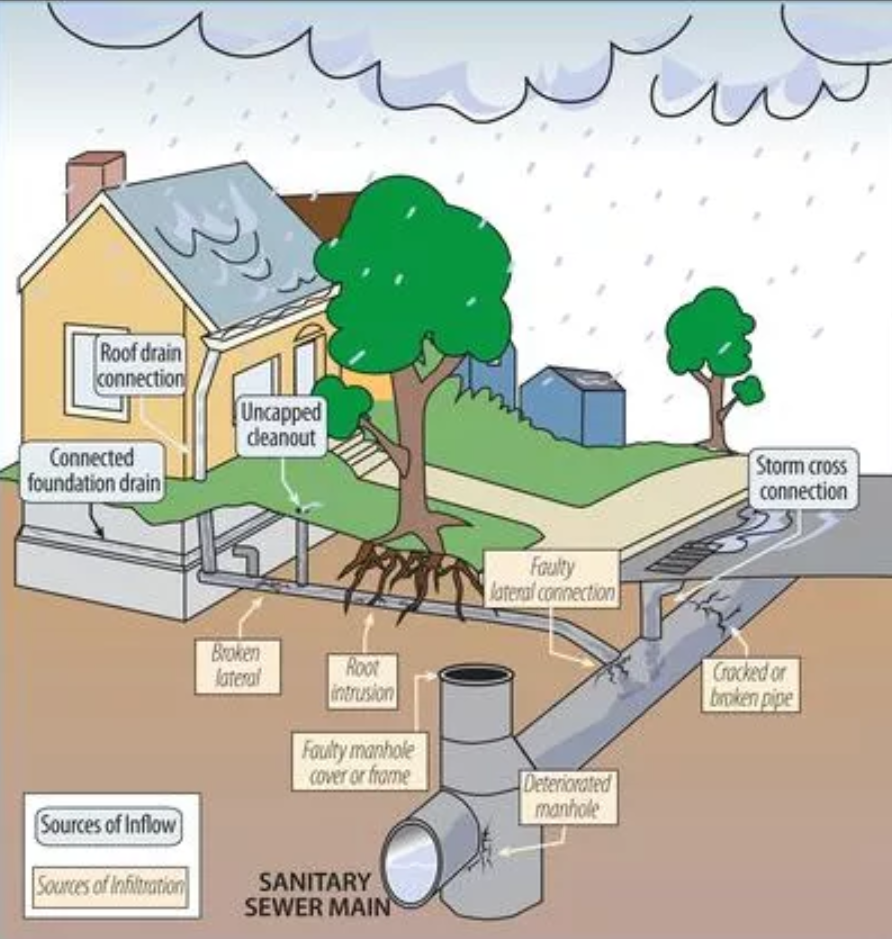
A: I/I, or Inflow and Infiltration, is surface water and groundwater that enters the collection system that flows to the City Wastewater Treatment Plant. The additional volume of water can surge dramatically in the spring due to rain-on-snowstorm events. During this time, flows that reach the plant for treatment may increase to nearly 10 times normal levels. Reducing I/I would lower the volume of water requiring treatment at the Wastewater Treatment Plant.
Common sources of I/I include:
Cracks and holes in main system pipes
Broken or deteriorated lateral connections between homes, businesses, and mains
Sump pumps, yard drains, and roof drains improperly connected to the collection system
Uncapped cleanouts
Storm drain cross-connections
Q: Why should we address I/I?
A: All water that enters the wastewater treatment plant must be treated to the permit requirements, regardless of its source. The wastewater flow to the plant doesn’t stop. Reducing I/I lowers the amount of water needing treatment, saving money and reducing the risk of permit violations. The City has invested millions into I/I reduction projects in an effort to reduce the future sizing of the treatment plant while protecting water quality.
Learn more about the City implemented the Sewer Lateral Improvement Program (SLIP) to reduce inflow and infiltration (I/I) entering the sanitary sewer system through private sewer laterals at Sewer Lateral Improvement Program (SLIP) | Sandpoint, ID and Inflow & Infiltration (I/I) | Sandpoint, ID
Q: What are the current peak flows, and how much has I/I been reduced?
A: On a typical summer day, flows are about 1.8 million gallons per day. During wet-weather I/I events, flows can spike to 12–14 million gallons per day. Past I/I reduction programs have lowered peaks, but the plant must still be designed for high surges.
Q: Why not use an equalization basin or other alternatives for high flows?
A: Alternatives such as equalization basins were evaluated but were determined not to be cost-effective at the scale of Sandpoint’s wet-weather surges. The selected design is based on comprehensive engineering analysis.